
Secret Ocean.
Chapter 8. CS&RB II - The Intracoastal Waterway to Norfolk, Virginia, Cape Hatteras, and the fishermen.

🇺🇸🇮🇹 Bilingual content: English first, Italian follows
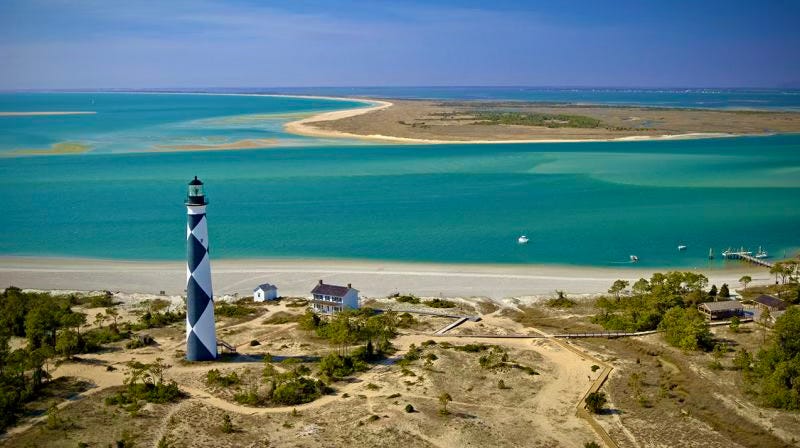
CS&RB II Busnelli is finally back in shape, thanks to the sacrifice of Richard the mechanic and the patience of the Coast Guard. Now, approximately 500 miles of the Intracoastal Waterway await us, crossing four states—Georgia, South Carolina, North Carolina, and Virginia—and passing charming cities like Charleston and wild natural environments like Cape Hatteras.
The CS&RB II Busnelli has two main problems: the height of the mainmast, 19.50 meters (63 feet), and the draft of 2.40 meters (8 feet). We already faced the problem of the mast height in Miami, forced to go out to the ocean because we couldn’t pass under a fixed bridge. According to the ICW charts, there are no fixed bridges in the next 500 miles. But the problem of the 8-foot draft on a “guaranteed” 10-foot seabed remains. Which in reality isn’t guaranteed. We’re sailing in Georgia strictly between the poles, green to starboard and red to port, as the IALA Red Right Return rule applies for north-south navigation. But we’re sailing south-north, so the rule is reversed, meaning red to port, as it should be in the European rules. But after a few miles, fortunately under power at only 5 knots, we come to a sudden and violent stop, causing even the children on deck to lose their balance and the chopped onion we were preparing to sauté for a sauce, complete with cutting board and knife, to fall to the floor. Our first grounding. Ten feet isn’t always guaranteed... The bottom of the canal is muddy, fortunately not sticky, and with a strong reverse gear we emerge unscathed, but with the sautéed onions to redo. It’s the first grounding. More will follow, and not quite a few. We prepare ourselves cautiously, reducing our speed by a knot. You never know. We have plenty of time to reach Norfolk and keep our appointment with the skipper. On the other hand, he’s not dying to get back on the boat at the moment.
The water in the ICW is murky, mixed with mud and decomposing vegetation, a uniform brownish hue that certainly doesn’t allow us to determine if the seabed has risen. The eco sounder tells us there’s no bottom when we’re already on the shoal. It has no predictive power. At least not the ones from the 1970s. So we’re left to rely on chance or luck.
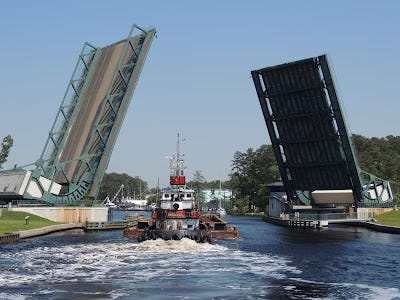
Ahead of us are several drawbridges, all made of iron, with a wide variety of shapes and opening systems. There are flat, arched, single-span revolving bridges, single-span or double-span lifting bridges, and bridges that can be raised with imposing side towers, rising the deck well over 20 meters. The procedure is fun and, for us Italians—unused to inland waterways except in Veneto, the Venice region, where the bridge operator is usually at the tavern with more than one “ombra” (white wine)—quite surprising. Next to the bridge is a guardhouse where the operator is permanently stationing during navigation hours, that is, between the ephemeris, 30 minutes before sunrise and 30 minutes after sunset. Approaching the bridge, which is obviously closed to allow vehicular traffic, we sound the horn three times, a simple horn with a can of compressed air. The operator instantly lowers the red and white barriers with flashing red lights, accompanied by a very high-pitched sound, to stop traffic, just like at our railway level crossings. Simultaneously, the bridge begins its opening movement, which, thanks to evidently very powerful motors, reaches full opening in just over a minute. One minute… After our wave and a horn greeting, the operator instantly closes the bridge and in less than two minutes raises the barriers to allow traffic to resume. No drivers complain, no one honks, everything proceeds in a civilized, mutually respectful manner.
Stories like this are the heartbeat of Yacht Lounge. If you value this level of insight, join our 3,800 active readers to receive weekly perspectives you won’t find anywhere else.
There are many bridges, but the entire ICW is one level so there are no locks, which would significantly slow the journey upstream toward Norfolk, except for just one in the last stretch of the Elizabeth River just before the city.
In the evening, after sunset, you can spend the night in one of the many mooring options, from docked side of the canal to full-fledged marinas with all the usual services these facilities offer, from restrooms and showers to waste collection, shops, bars, and restaurants, mostly fast food chains like McDonald’s, Kentucky Fried Chicken, and Pizza Hut. It’s not gourmet, but you can eat heartily and fatten up. For the supplies we refer to Seven Eleven Market, which doesn’t quite satisfy Carla’s high-end culinary aspirations. She has a collection of cuisine cards from Elle, the French magazine, described as “photographable” in his 1969 film “Capricci” by Carmelo Bene, the brilliant, iconoclastic and multifaceted Italian actor who radically transformed the theater, defining himself as an “acting machine” composed of author, director, actor, and costume designer. He challenged traditional theater with his extreme research into voice, body, and the deconstruction of text, influencing generations and becoming a fundamental turning point in twentieth-century Italy. But because Carla is an adaptable, imaginative, and intelligent woman, she knows how to create truly respectable dishes even from questionable, yet undeniably American, ingredients, to the great satisfaction of the entire small crew, especially Paolo, the greediest of all.
After another series of groundings, all without consequences and to which we’re becoming accustomed, we arrive at a dock where a thirty-meter motor superyacht stands out. There are only two people on board, a wealthy retired couple in their seventies who are piloting the motoryacht by themselves. On the upper deck, alongside the tender, stands a Mini Moke, the small, open-top recreational vehicle based on the Mini chassis designed by Alec Issigonis. The tender’s crane also serves to land the Mini Moke, allowing the sprightly couple to cruise the American countryside independently.
We’re a third of the way into Norfolk, and the historic and charming city of Charleston appears ahead, where we must stop to await another money transfer from Italy. We moor at the Charleston Maritime Center on the Cooper River, located within walking distance of the city’s historic center.
In the 19th century, South Carolina was the richest state in the Confederacy. Charleston, the capital, was the wealthiest city. It grew rich from the slave trade over long, cruel decades, during which the city, founded in 1670 in honor of king Charles II of England, was the port of call for the majority of African slaves destined for North America. Of the approximately 390,000 slaves arriving from the coasts of West Africa, 150,000 passed through the docks of Charleston’s port. This was more than any other port in the country. At Gadsden’s Wharf, the slaves were stored in brick warehouses, waiting for weeks, sometimes months, to learn their fate: to be sold at the market in the French Quarter and end up on a plantation. With its low houses, wrought-iron balconies, narrow streets, brick churches, and the colonial allure that surrounds the historic center built on the peninsula, Charleston was the epicenter of human trafficking. Carla, the children, Daniela, and were roaming in the narrow streets of the historic center and the French Quarter, searching for Southern folklore, while Paolo hunts for a bar where enjoying a fresh, cool beer.
We meet back on the boat in the evening, and Paolo shows up with a new friend, Geoff Cross, aka Jeff, a Welsh sailor who made an Atlantic crossing from Gibraltar to Charleston with a client owner of a 12-meter sailboat. He’s a gym teacher with a passion for sailing, and has extensive sailing experience. He seems to have been taken straight from a 19th-century print of the English navy; his greasy hair is tied in a ponytail, like the sailors of the time, and his blouse with that large collar that served as a protection to his neck from wind and spray, due to his long hair tied in a ponytail, was completed by the collar, the canvas collar guard made an integral part of the Royal Navy uniform in 1857.
Jeff is very polite and kind, but slightly smelly. He asks permission to come aboard, and once we’ve introduced ourselves and gotten acquainted with each other over another beer, he asks, “Are you sailing back to England? Could you give me a ride?” We quickly exchange glances with the two women and gladly agree. Two more experienced hands can only help our limited crew. The skipper will be happy, too, we’re sure. And it’ll also help us improve our English. Jeff thanks us with a big smile and asks permission to go getting his personal effects, and reappears shortly after with the classic, long, and narrow seaman’s sack made of raw canvas, where, among other things, he’s managed to stow a blazer. “What do you do with a wrinkled blazer in your not-so-scented sack?” I ask curiously. “Well, you know, if I were to join a yacht club along the route...” An innate class beyond appearances.
Listen to the podcast 👇

After the usual week of waiting for the transfer with a daily pilgrimage to the local Chase Manhattan Bank, finally recharged with greenbacks, we resume our slow march north. Jeff greatly appreciates the inland waterways, which in England, especially in the south, constitute a dense network he knows well and which in the 19th and early 20th centuries represented efficient, low-cost transportation routes. However, he asks us to test the boat on the ocean to begin to familiarize ourselves with sails and real navigation. Why not? Thus, we speed up the journey a bit, but we return into the ICW through the Morehead City inlet, North Carolina, to sail the protected waters of Pamlico Sound, which opens up within the sandbanks of Cape Hatters.
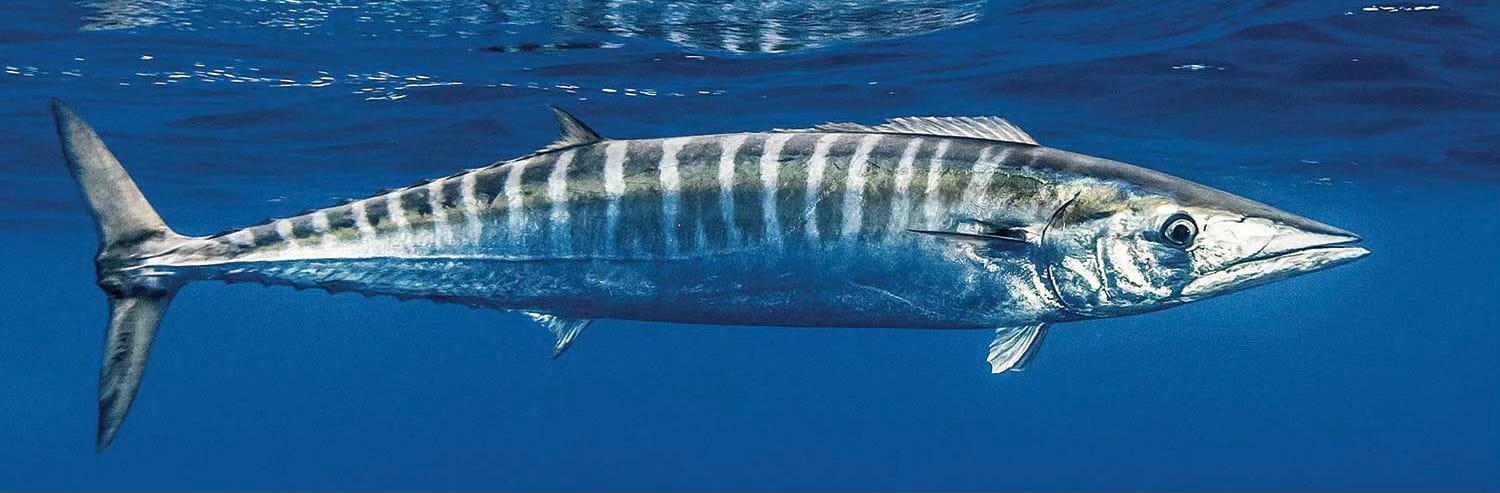
Finally, out on the ocean, after thousands and thousands of miles of dissatisfaction and fruitless attempts at catching fish with his Italcanna, the fishing rod, Paolo hears the reel’s buzzer frantically ringing. And this time it’s no joke. With Jeff’s help, after a tiring struggle with the rod, bent like a reed, a fish that easily measures our height is hauled aboard. It’s almost two meters long, actually, not by the fisherman’s yardstick, which is notoriously over a yard long. It’s beautiful, striped, long, and muscular. I run to get the book on tropical fish, but he doesn’t appear. There’s a barracuda, there’s a dolphin fish, but he’s not there. I suggest throwing him back into the sea before he dies. Paolo almost strangles me with his fishing line. All right, so what do we do with it? Will it be edible? How do we preserve it? We have a deep-chested freezer on board. I suggest at least putting it in there. Much to Jeff’s amusement, who isn’t a fisherman but who happily supports his new friend Paolo, we bend it into a U-shape and laboriously slide it into the freezer. Then in Morhead City, which we know is a port for amateur deep-sea fishing, we’ll see what to do.
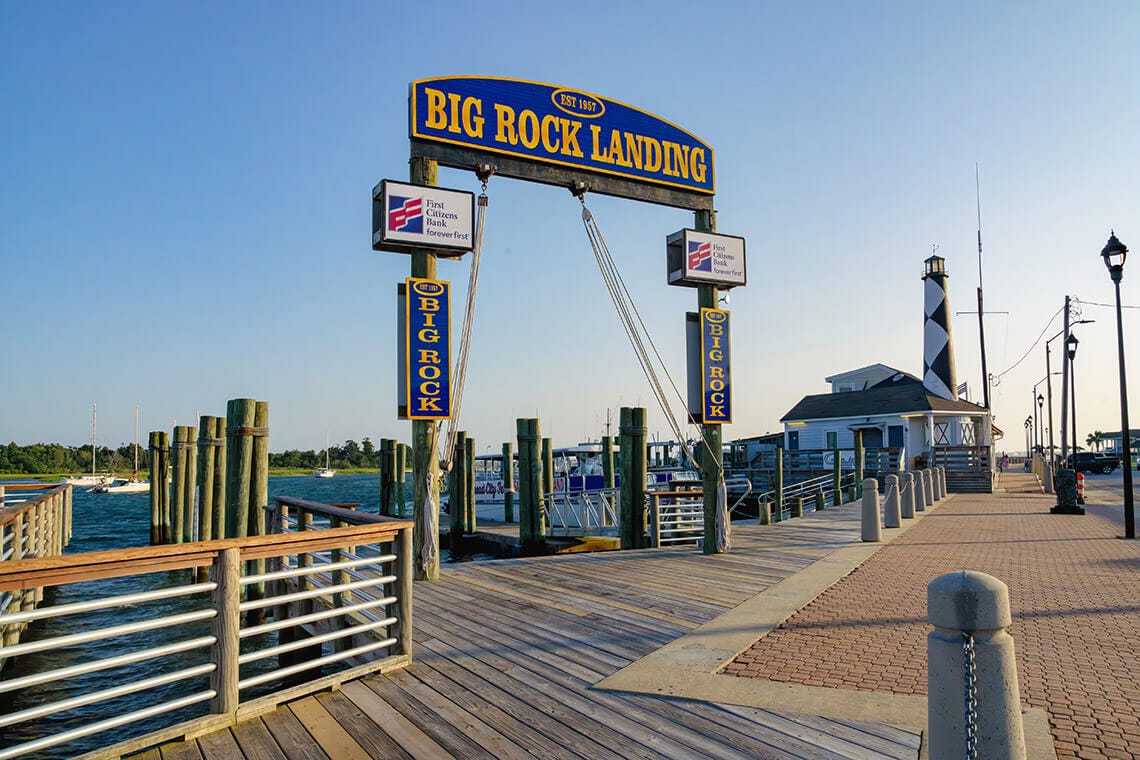
Morehead City is located opposite Beaufort, another port for amateur deep-sea fishing. Between the two ports, about 3,000 fishing boats are moored, American fishermen boats, like Hatteras, Bertram, Pursuit, Mako, and so on. They should know what kind of fish it is. We dock at Big Rock Landing, take the fish out of the freezer, and leave it in the sun for a while to straighten it out. The three of us sling it over our shoulders, followed by the children, eager to see what it’s all about, and we head towards the fishing club along the wooden dock. We ask a small group of fishermen looking like they’re straight out of the 1972 film “Deliverance.” They reply, alternating words like Huey, Dewey, and Louie, that it’s a Whaoo. “Is it edible?” I ask. With one single voice, they answer, “Nooo...” We look each other in the eye. “What do we do? Leave it here?” They give us a look that’s half ironic, half mocking. “We’ll take care of disposing of it,” they say. We thank them, somewhat hesitantly. Too friendly. In fact, two nights later, at a restaurant, the menu featured a Cape Lookout-style Wahoo steak. At least Paolo had the satisfaction of catching a fish.
The Pamlico Sound is as big as a lake, and once we’re back underway, we enjoy the satisfaction of sailing a few miles on inland waters, much to Jeff’s delight, revealing himself also as a true freshwater sailor.
The last twelve miles along the Elizabeth River to Norfolk took us at least three hours. We had to go through the ICW’s only lock and cross a couple of swing bridges, but the longest wait was for a railway lift bridge. Norfolk is the largest military port in the world, crowded with hundreds of ships, from small tugboats to enormous aircraft carriers to mighty nuclear submarines. We’re fortunate to be staying as guests on a private dock in historic downtown Norfolk, with water and electricity. It’s a delightful place, with old red brick houses and cobblestone streets, brought from England a hundred years ago as ballast in the bilges of sailing ships.
The skipper will arrive in two days, to the great satisfaction of the children who have suffered from his absence for two months, and life will return almost to normal, after 22 groundings in the ICW and one more crew member.
by Roberto Franzoni
(English translation and editing: Elena Paxia)
(Italian Follows)
✦ To be continued in the next episode…
Yacht Lounge grows through word of mouth among curious minds. If this story inspired you, share it with those who navigate your same routes.
Here you can find the link to the previous episode 👇

Chapter 8. CS&RB II -L’Intracoastal Waterway fino a Norfolk Virginia, Capo Hatteras e i pescatori.
Finalmente il CS&RB II Busnelli è tornato in forma, grazie anche al sacrificio di Richard il meccanico e alla pazienza della Coast Guard. Ora ci attendono circa 500 miglia di Intracoastal Waterway, attraversando quattro stati, la Georgia, il South Carolina, il North Carolina e la Virginia e incontrando fascinose città come Charleston e ambienti naturali selvaggi come il Cape Hatteras.
I problemi principali del CS&RB II Busnelli sono due: L’altezza dell’albero di maestra di 19,50 metri ovvero 63 piedi e il pescaggio di 2,40 metri, pari a 8 piedi. Con il problema dell’altezza dell’albero ci siamo già misurati a Miami, costretti a uscire in oceano perché non passavamo sotto a un ponte fisso. Nelle prossime 500 miglia di ponti fissi non ce ne sono, stando alla cartografia dell’ICW. Ma rimane il problema del pescaggio di 8 piedi su un fondale “garantito” di 10 piedi. Che in realtà garantito non è. Stiamo navigando in Georgia rigorosamente tra i pali, per noi verde a dritta e rosso a sinistra, in quanto la regola IALA del Red Right Return, ovvero del rosso a dritta, si applica per la navigazione nord-sud. Ma noi navighiamo sud-nord e quindi la regola è invertita, ovvero giusta per noi, rosso a sinistra, come deve essere. Ma dopo poche miglia, navigando a motore per fortuna a soli 5 nodi subiamo uno stop brusco e violento che fa perdere l’equilibrio anche ai bambini in coperta e cadere al suolo il trito di cipolla in preparazione del soffritto per un sugo con tanto di tagliere e mezzaluna. Primo arenamento. I 10 piedi non sono proprio garantiti sempre… Il fondo è di fango, fortunatamente non vischioso, e con una robusta marcia indietro ne usciamo indenni, ma col soffritto da rifare. È il primo arenamento. Ne seguiranno altri e non pochi. Ci prepariamo, circospetti, riducendo di un nodo la velocità. Non si sa mai. Tanto di tempo per raggiungere Norfolk e rispettare l’appuntamento con lo skipper ne abbiamo. D’altro canto lui al momento non muore dalla voglia di tornare in barca.
L’acqua dell’ICW è torbida, mescolata di fango e vegetazione in decomposizione, di un marroncino uniforme che non consente certo di capire se c’è un rialzamento del fondo. Il profondimetro, o ecoscandaglio se vi piace di più, ci dice che non c’è fondo quando siamo già sulla secca. Non ha capacità predittiva. Almeno quello degli anni 70. Così non rimane che affidarsi al caso o alla fortuna.
Davanti a noi si presentano parecchi ponti mobili che sono tutti in ferro, con un’ampia fantasia di forme, di reticoli, di sistemi di apertura. Ce ne sono di piatti, ad arco, girevoli a una campata, apribili con sollevamento a una campata o a due campate, sollevabili con imponenti torri laterali sui cui lati l’impalcato si alza ben sopra i 20 metri. La procedura è divertente e per noi italiani, non abituati alle acque interne se non in Veneto, dove normalmente l’operatore del ponte è all’osteria in compagnia di più di un’ombra (vino bianco), del tutto sorprendente. A fianco del ponte si trova una guardiola dove l’operatore siede permanentemente nell’orario di apertura alla navigazione, ovvero tra le effemeridi, 30 minuti prima dell’alba e 30 minuti dopo il tramonto del sole. Avvicinandoci al ponte, che è ovviamente chiuso per consentire il traffico veicolare, diamo tre suoni di avvisatore acustico, una banale tromba con bomboletta di aria. L’operatore istantaneamente abbassa le sbarre bianche e rosse con luci rosse lampeggianti, accompagnate da un suono acutissimo, per fermare il traffico, come in un nostro passaggio a livello ferroviario. Simultaneamente il ponte inizia il suo movimento di apertura, che grazie a motori evidentemente molto potenti, arriva ad apertura completa in poco più di un minuto. Un minuto… Passati, ringraziato l’operatore con un saluto alla mano e alla trombetta, lui istantaneamente chiude il ponte e in meno di due minuti alza le sbarre per far riprendere il traffico. Nessun automobilista si lamenta, nessuno suona il clacson, tutto si svolge in un civile rispetto reciproco.
I ponti sono tanti, ma tutta l’ICW è complanare e non ci sono chiuse, che rallenterebbero non poco la risalita verso Norfolk, tranne una finale nel tratto finale dell’Elisabeth river poco prima della città.
Alla sera, tramontato il sole, si pernotta in una delle numerose possibilità di ormeggio, da tratti banchinati a veri e propri marina con tutti i servizi usuali che queste strutture offrono, dai servizi igienici e le docce, alla raccolta dei rifiuti, a negozi, bar e possibilità di ristorazione che prevalentemente sono rappresentate dalle catene di fast food, come Mc Donald, Kentucky Fried Chicken, Pizza Hut. Non è gourmet ma si mangia con gusto all’ingrasso. Per il bordo si fanno provviste al Seven Eleven Market, che non soddisfa appieno le aspirazioni di cucina di alto livello di Carla, che dispone di una raccolta di schede della cucina di Elle, la rivista francese, definita “da fotografare” nel suo film “Capricci” del 1969 da Carmelo Bene, il geniale attore italiano iconoclasta e poliedrico, che ha radicalmente trasformato il teatro, definendosi una “macchina attoriale” composta da autore, regista, attore, costumista, e che ha sfidato il teatro tradizionale con una ricerca estrema sulla voce, il corpo e la destrutturazione del testo, influenzando generazioni e diventando un punto di svolta fondamentale nel Novecento italiano. Ma poiché Carla è una donna adattabile, fantasiosa e intelligente sa trarre anche da ingredienti discutibili, ma indiscutibilmente americani, dei piatti di tutto rispetto, con grande soddisfazione di tutto il ristretto equipaggio, in particolare di Paolo, più goloso di tutti.
Dopo un’altra serie di arenamenti, tutti senza conseguenze e a cui stiamo facendo l’abitudine, approdiamo a un ormeggio banchinato dove spicca un superyacht a motore di una trentina di metri dove a bordo ci sono solamente due persone, una coppia di facoltosi pensionati circa settantenni che conducono da soli quel motoryacht sul cui ponte superiore, a fianco del tender, spicca una Mini Moke, la piccola vettura scoperta per il tempo libero, basata sul pianale della Mini progettata da Alec Issigonis. La gru di movimentazione del tender serve anche a mettere a terra la Mini Moke, che consente all’arzilla coppietta di girare autonomamente nella campagna americana.
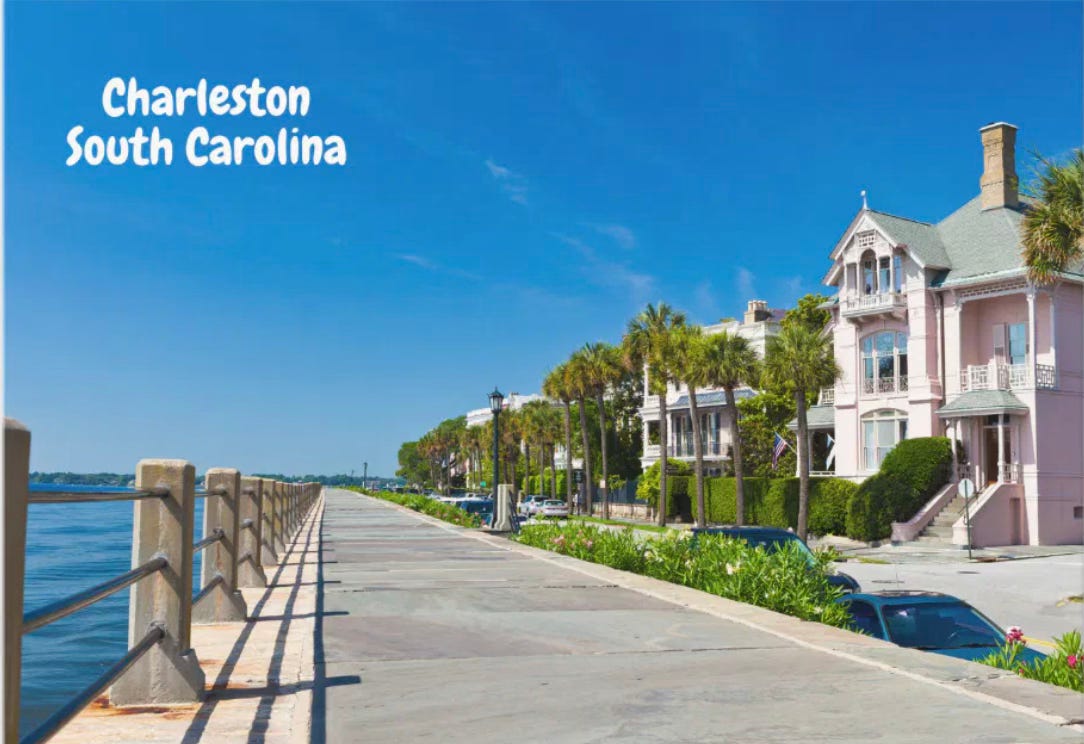
Siamo a un terzo del nostro avvicinamento a Norfolk e alla nostra prua appare la storica e fascinosa città di Charleston dove dobbiamo fermarci per aspettare un altro bonifico dall’Italia. Ci ormeggiamo al Charleston Maritime Center sul Cooper river, che si trova a ridosso del centro storico della città, a distanza pedonale.
Storie come questa sono il cuore di Yacht Lounge. Se apprezzi questo tipo di narrazione, unisciti ai nostri 3.800 lettori attivi per ricevere ogni settimana approfondimenti che non troverai altrove.
Nel XIX secolo la South Carolina era lo stato più ricco della Confederazione. Charleston, la capitale, ne era la città più facoltosa. Arricchitasi con il commercio degli schiavi in decenni lunghi e spietati in cui la città fondata nel 1670 in onore di Carlo II d’Inghilterra è stata il porto d’approdo per la maggioranza degli schiavi africani destinati al Nord America. Dalle banchine del porto di Charleston sono passati 150mila dei circa 390mila schiavi arrivati dalle coste dell’Africa occidentale. Più che in qualsiasi altro porto del Paese. Al Gadsden’s Wharf c’erano i magazzini in mattoni, dove venivano stivati gli schiavi in attesa, per settimane, alle volte mesi, di sapere il loro destino di venir venduti al mercato, nel quartiere francese, e finire in una piantagione. Con le sue case basse, le balconate di ferro battuto, le vie strette, le chiese di mattoni, l’allure coloniale che circonda il centro storico edificato sulla penisola, Charleston è stato l’epicentro del traffico di essere umani.
Carla, i bambini Daniela e io ci perdiamo tra le strette vie del centro storico e del quartiere francese alla ricerca del folklore degli stati del sud, mentre Paolo si mette alla caccia di un bar dove scolarsi una bella birra fresca.
Ci ritroviamo in barca alla sera e Paolo si presenta con un nuovo amico, Geoff Cross, detto Jeff, un marinaio gallese che ha effettuato una traversata atlantica da Gibilterra con un cliente proprietario di una barca a vela di 12 metri. È un insegnate di ginnastica appassionato di vela, con una vasta esperienza di navigazione. Sembra materializzato da una stampa sulla marina inglese dell’Ottocento, porta i capelli, unticci, legati con un codino, come i marinai di allora, per cui la giubba con quel collettone che serviva a proteggere il collo da vento e spruzzi veniva protetto, a causa dei capelli lunghi legati a coda, dal solino, quella protezione in tela del colletto reso parte integrante della divisa dalla Royal Navy nel 1857.
Ascolta il podcast di Oceano Segreto 👇

Jeff è molto educato e gentile, leggermente maleodorante. Chiede il permesso di salire a bordo e una volta fatte le presentazioni e familiarizzato con un’altra birra, chiede: “are you sailing back to England? Could you give me a ride?”. Ci guardiamo rapidamente negli occhi con le due donne e acconsentiamo volentieri. Due braccia esperte in più non ci possono che fare bene. Ne sarà contento anche lo skipper, ne siamo certi. E in più ci serve per migliorare l’inglese. Jeff ringrazia con un gran sorriso e un inchino, chiede il permesso di andare a prendere i suoi effetti personali e ricompare poco dopo con il classico sacco da marinaio in tela grezza, stretto e lungo, dove tra le altre poche cose è riuscito a stivare anche un blazer. “Che te ne fai di un blazer tutto spiegazzato nel tuo sacco non profumatissimo…” gli chiedo curioso. “Mah, sai, se dovessi entrare in uno yacht club lungo la rotta…”. Una classe innata al di là delle apparenze.
Dopo la solita settimana di attesa del bonifico con pellegrinaggio quotidiano alla Chase Manhattan Bank locale, finalmente ricaricati di “verdoni” riprendiamo la lenta marcia verso nord. Jeff apprezza molto le acqua interne, che in Inghilterra, soprattutto meridionale, costituiscono una fitta rete che lui conosce bene e che nell’Ottocento e primo Novecento rappresentarono vie di trasporto efficiente a basso costo. Ci chiede però di provare la barca in oceano per cominciare a familiarizzare con le vele e la navigazione vera. Perché no? Acceleriamo così un po’ il cammino, ma rientriamo in North Carolina a Morehead City per navigare nelle acque protette del Pamlico Sound, che si apre all’interno delle barene di sabbia del Cape Hatters.
In oceano, finalmente, Paolo dopo migliaia e migliaia di miglia di insoddisfazione e di inutili tentativi di cattura con la sua Italcanna sente suonare freneticamente il cicalino del mulinello. E questa volta non è uno scherzo. Con l’aiuto di Jeff, dopo una lotta faticosa alla canna, piegata come un giunco, viene issato a bordo un pesce che misura abbondantemente le nostre altezze. È di quasi due metri, per davvero, non col metro del pescatore, notoriamente più lungo di 100 centimetri. È bellissimo, tigrato, lungo, muscoloso. Corro a prendere il libro dei pesci tropicali, ma lui non compare. C’è il barracuda, c’è la lampuga, ma lui non c’è. Suggerisco di ributtarlo in mare prima che muoia. Paolo a momenti mi strangola con la lenza. Va bene, allora che ce ne facciamo? Sarà edibile? Come lo conserviamo? A bordo abbiamo un freezer a pozzetto profondo. Propongo di metterlo almeno là dentro. Con gran divertimento di Jeff, che non è pescatore, ma che tiene volentieri bordone al suo nuovo amico Paolo, lo pieghiamo a U e lo infiliamo con fatica nel freezer. Poi a Morhead City, che sappiamo essere porto di pescatori amatoriali d’altura, vedremo il da farsi.
Morehead City è situata di fronte a Beaufort, un altro porto di pescatori amatoriali d’altura. Tra i due porti sono ormeggiate circa 3.000 barche da pesca, fisherman americani tipo Hatteras, Bertram, Pursuit, Mako, e via pescando. Dovrebbero sapere che pesce è. Approdiamo al Big Rock Landing, estraiamo il pesce dal freezer e lasciatolo al sole per un po’ lo raddrizziamo. In tre ce lo mettiamo in spalla, seguiti dai bambini curiosissimi di capire che cosa sarà e ci avviamo al circolo di pesca lungo la banchina di legno. Chiediamo lumi a un gruppetto di pescatori con l’aspetto da “Un tranquillo weekend di paura”; film del 1972. Ci rispondono alternando le parole come Qui, Quo, Qua che si tratta di un Whaoo. “È commestibile?” chiedo. In coro rispondono ”Nooo…”. Ci guardiamo negli occhi. “Che facciamo? Lo lasciamo qui?” Loro ci lanciano uno sguardo tra ironico e beffardo e “Ci pensiamo noi a smaltirlo”. Ringraziamo, con qualche perplessità. Troppo affabili. Infatti due sere dopo a un ristorante nel menù spiccava il trancio di Wahoo “Cape Lookout style”. Almeno Paolo ha ricavato la soddisfazione di una preda.
Il Pamlico sound è grande come un lago e ripresa la navigazione ci togliamo la soddisfazione di navigare per qualche miglio a vela in acque interne, con gran piacere di Jeff che dà il suo meglio come marinaio anche di acqua dolce.
Le ultime dodici miglia lungo l’Elisabeth river fino a Norfolk ci hanno preso almeno tre ore. Abbiamo dovuto attraversare l’unica chiusa dell’ICW e superare un paio di ponti girevoli, ma l’attesa più lunga è stata quella di un ponte ferroviario a sollevamento. Norfolk è il più grande porto militare del mondo, affollato di centinaia di navi, da piccoli rimorchiatori a enormi portaerei a poderosi sommergibili atomici. Abbiamo la fortuna di soggiornare come ospiti in un molo privato nel centro storico di Norfolk, con acqua ed elettricità. È un posto delizioso, con vecchie case in mattoni rossi e strade acciottolate, portate dall’Inghilterra un centinaio di anni fa come zavorra nella sentina dei velieri.
Fra due giorni arriva lo skipper ,con gran soddisfazione dei bambini che ne hanno sofferto per due mesi la lontananza, e la vita ritornerà quasi normale, dopo ben 22 arenamenti nell’ICW e un membro d’equipaggio in più.
by Roberto Franzoni
✦ Continua nella prossima puntata…
Yacht Lounge cresce grazie al passaparola tra menti curiose. Se questo racconto ti ha ispirato, condividilo con un amico.
Qui puoi trovare l’episodio precedente 👇
The juxtaposition of practical seamanship challenges - the 22 groundings, the drawbridge procedures, the eight-foot draft on a questionable ten-foot bottom - against the rich historical tapestry of Charleston creates a compelling narrative texture. Your observation about the difference between American and European IALA rules for channel markers is exactly the kind of detail that separates lived experience from armchair sailing. The Wahoo incident perfectly captures the comedic reality of offshore fishing: the triumph of the catch followed by the puzzlement of identification and the locals' knowing smirks. Looking forward to the next chapter.