


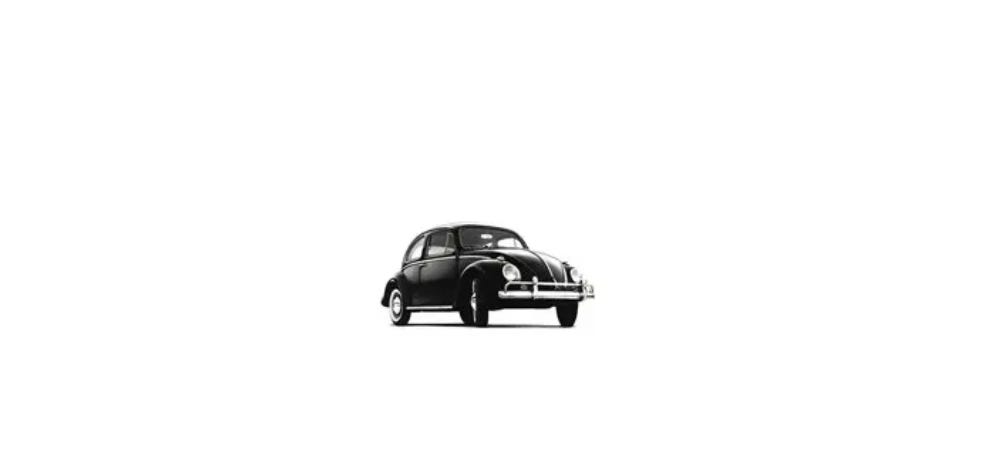
It was 1959. You flip open an American magazine — Life, Look, the Saturday Evening Post — and you expect the usual glossy spreads: Cadillacs with shark fins taking up the full double page, chrome gleaming with the promise of prosperity, an eternally blue sky, the American family smiling in the driveway. Instead, you find this: a white page, almost entirely empty. In one corner, small, almost shy, a car. Below it, three words in a modest typeface: Think Small.
No promise of power. No blonde on the hood. No illusion of status. Just a foreign car: round, odd-looking, photographed with surgical honesty. And a headline that read: “Our little car isn’t so much of a novelty any more.” An opener that would have gotten anyone fired at any other agency on Madison Avenue.
That white page changed advertising forever. And, even if no one knew it yet, it had something to say about the sea.
Bill Bernbach’s Quiet Revolution
To understand what made Think Small revolutionary, you have to understand postwar America. Fifteen years after V-Day, the United States had become the global superpower of consumption. GDP was climbing, families were growing, suburbs were spreading. And the automobile was the symbol of all of it: bigger, more powerful, more chrome. The Detroit Big Three, Ford, General Motors, Chrysler, were locked in a race to see who could build the most extravagant machine. The Cadillac Eldorado, with its fighter-jet tail fins, was the icon of the age.
Into this landscape stepped Carl Hahn, president of Volkswagen of America, facing a problem that was almost comically hopeless. He needed to sell the Beetle: small, round, engine in the back, originally designed on commission from Adolf Hitler, to an American public that wanted nothing but big cars. Previous attempts had been lukewarm: agencies trying to pass the VW off as “an American car,” papering over its oddities with a veneer of forced familiarity.
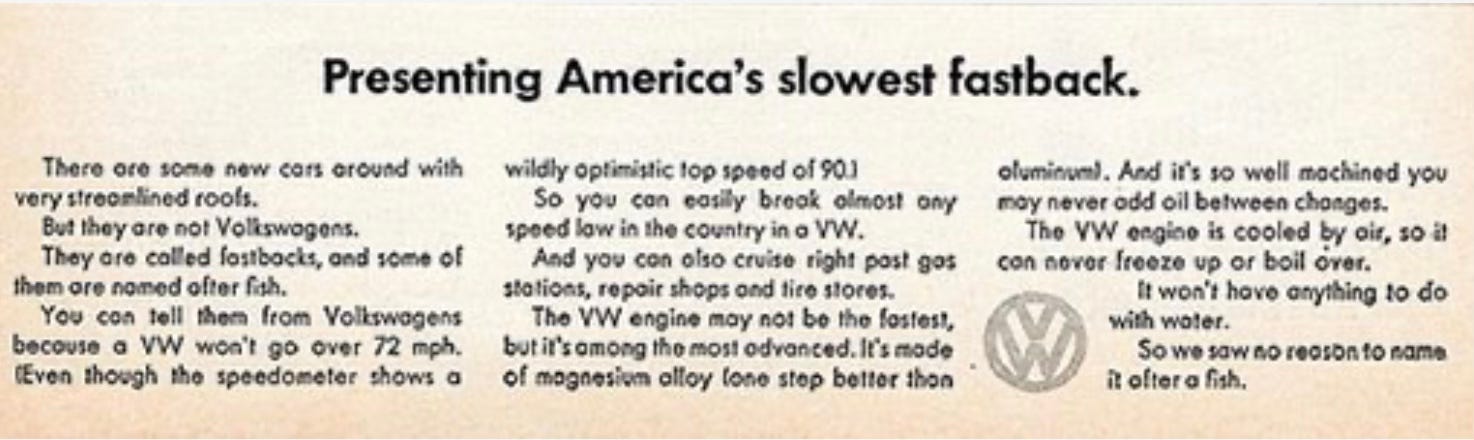
Hahn brought the problem to Bill Bernbach, more philosopher than adman, firmly convinced that communication should treat consumers as intelligent adults, capable of irony and self-awareness. Bernbach handed the project to art director Helmut Krone and copywriter Julian Koenig. Their solution was as simple as it was brilliant: lean all the way into what the Beetle actually was. Small? Yes, small. Strangely designed? Yes, strangely designed. Unlike anything else on the road? Exactly. The campaign hid nothing instead, it turned every so-called flaw into a selling point. One ad ran the word “Lemon” across a photo of the car, then explained that this particular Beetle had been pulled from the line by a quality inspector for a hairline blemish on the glove compartment chrome. That was the whole point: that’s why VWs were so reliable.
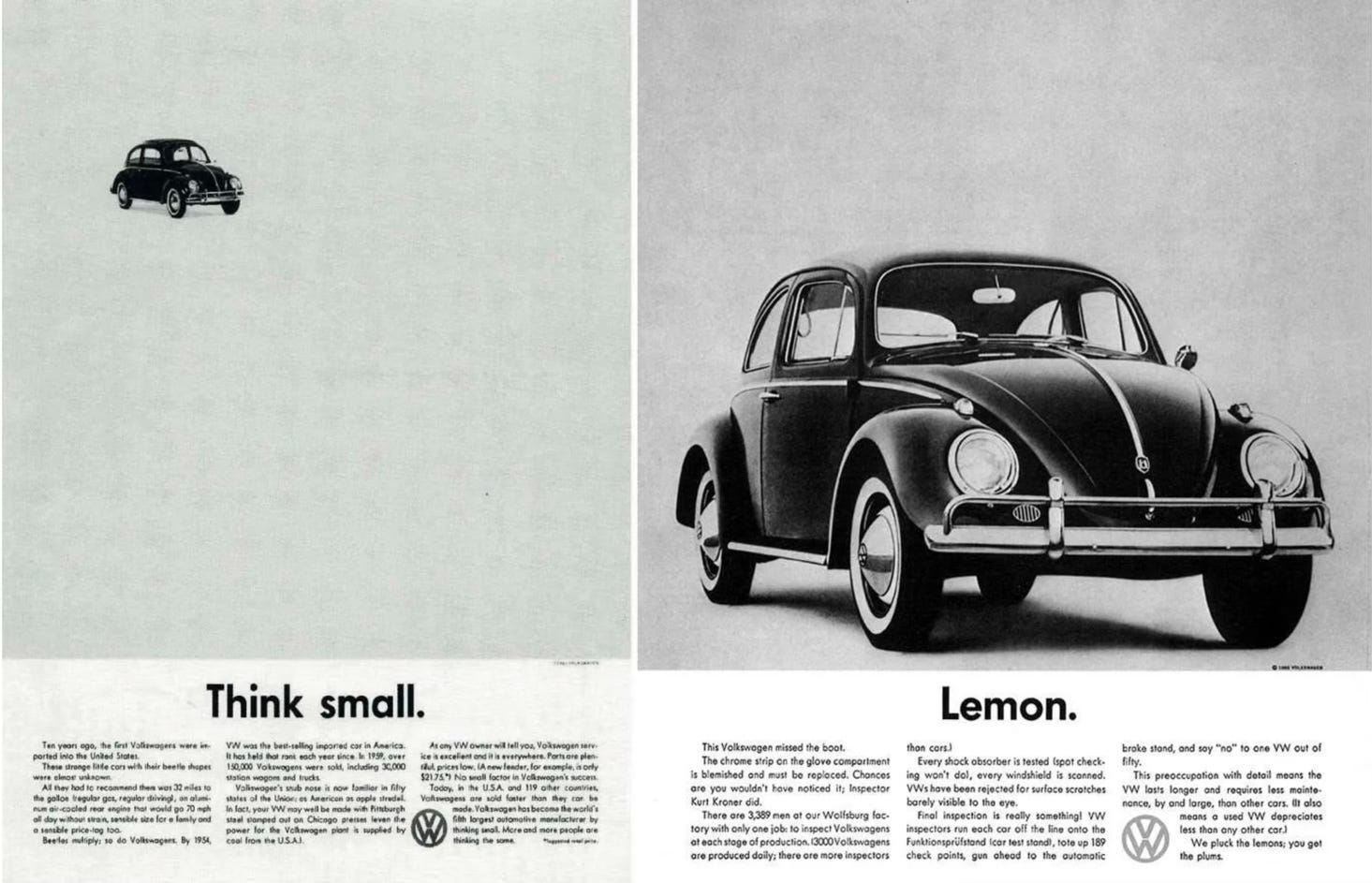
It was Ad Age, the industry bible, that later crowned the campaign the best of the twentieth century. Not the highest-grossing. Not the most expensive. The best. Because it didn’t just change Volkswagen’s fortunes, it changed the way the entire industry thought about communication. Before: polished illustrations, inflated promises, a paternalistic tone. After: raw photography, sharp wit, respect for the reader.
Think Small wasn’t selling a car. It was selling a way of being in the world: “Beetle ownership allowed you to show off that you didn’t need to show off.” It was counterculture before counterculture had a name.
“Maybe we got so big because we thought small.” — Original headline, VW Think Small, 1959
The Sea Is Not Measured in Meters
Now let’s take that same idea out to sea.
Today, when superyachts come up, the numbers are staggering. REV Ocean: 600 feet long, the largest private yacht ever built, conceived for ocean research but, let’s be honest, also for the view from Monaco harbor. The concepts Lürssen and Oceanco roll out each year at the Monaco or Dubai shows push past 650 feet, with private cinemas, infinity pools, support submarines and helicopter pads. Singulart, Aqua, Triple Deuce: names that evoke floating skyscrapers more than boats.
The market is unambiguous: in 2024, orders for superyachts over 200 feet hit a new record. Tech and energy billionaires are competing by the linear foot, just as Detroit once competed by the horsepower. Same game, sixty years later, moved offshore.
Stories like this are the heartbeat of Yacht Lounge. If you value this level of insight, join our 3,800 active readers to receive weekly perspectives you won’t find anywhere else.
The problem and this is the heart of it, is that these floating monuments rarely actually sail. They anchor. They are Instagram photographs moored in the bays of Portofino or Mykonos, floating hotels managed by crews of twenty, luxury bunkers built to be seen, not to see. The owner comes aboard for a few weeks a year, surrounded by staff, guests, sommeliers and personal trainers. The sea is the backdrop.
Think Small, in the deepest sense Bernbach intended, means something radically different: sailing.
Joshua Slocum understood this. In 1895, he set out from Boston aboard the Spray, 38 feet, built by his own hands, on what would become the first solo circumnavigation in history. Three years, 46,000 miles, no radio, no GPS, no crew. Just him, the wind, the currents, and a chronometer. His Sailing Alone Around the World is still one of the most-read sailing books in the world. Nobody remembers the name of the largest private yacht of his era. Everyone remembers Slocum.👇

There is something physically different about life aboard a 40- to 60-foot boat compared to a superyacht. On a small boat, the sea gets inside your life. You feel the roll, that constant dance that unsettles you at first and then, after a few days, becomes the rhythm of your breathing. You feel the salt on your skin, the wind shifting, the shrouds creaking at night. The helm, especially a tiller, transmits every variation in the sea directly into your hands.
The boat is not a tool; it is an extension of your nervous system.
On a superyacht with gyroscopic stabilizers and auto-routing systems, none of that exists. The sea is muffled, filtered, neutralized. You’re in a hotel that happens to move.
The authentic pleasure of the sea, the thing that real sailors can never quite explain to those who haven’t felt it, is made of small, concrete things. It’s finding a secure anchorage in a deserted cove in the Aeolian Islands that appears on no chart, reaching it after three hours on a beat, diving into water no superyacht tender could reach because of the draft. It’s cooking pasta in the cockpit in two-meter swells, laughing. It’s waking at four in the morning to change a headsail and finding yourself alone under a sky full of stars, with that fleeting, authentic sense that you’ve understood something essential.
None of that is purchased with feet and inches. It’s earned through skill and simplicity.
A well-rigged 40- to 50-footer lets you enter ports where superyachts can’t even send the tender. It lets you leave in three hours instead of three weeks of logistics. It lets you be the skipper instead of a passenger. And it gives you access to a whole range of experiences: the satisfaction of a clean maneuver, reading a weather front correctly, handling a minor emergency that build a relationship with the sea that simply cannot be bought.
This isn’t about deprivation or nostalgia. It’s about deliberate choice.
The same choice made by the person in 1959 America who bought a Beetle instead of a Cadillac. Not because they couldn’t afford the Cadillac, but because they understood that real value lived somewhere else.
Living aboard, and we’ve written about the sailors who have chosen the sea as home

is not a question of square footage but of relationship. Those who have chosen to live on a 50-foot boat, often after selling a large apartment, haven’t given up comfort: they’ve discovered that real comfort is something else entirely. It’s waking up on the water, deciding that morning where you want to go, with the whole world open ahead of the bow.
Think Small is not a retreat. It’s a conquest. Slocum circled the globe on 38 feet and some lessons, written in wood and salt, never age.
by Andrea Baracco
(Italian Follows)

Yacht Lounge grows through word of mouth among curious minds. If this story inspired you, share it with those who navigate your same routes.
Think Small.
Era il 1959. Apri una rivista americana — Life, Look, il Saturday Evening Post — e ti aspetti le solite pagine patinate: Cadillac con pinne da squalo che occupano l’intera doppia pagina, cromature che riflettono sogni di prosperità, un cielo sempre azzurro, la famiglia americana sorridente sul vialetto di casa. E invece trovi questo: sfondo bianco, quasi interamente vuoto. In un angolo, piccola, quasi timida, una macchina. Sotto, tre parole in carattere modesto: Think Small.
Nessuna promessa di potenza. Nessuna donna bionda sul cofano. Nessuna illusione di status. Solo un’automobile straniera, tonda e bizzarra, fotografata con onestà chirurgica. E un testo che iniziava così: “Our little car isn’t so much of a novelty any more.” La nostra piccola macchina non è più una grande novità. Un inizio che avrebbe fatto licenziare chiunque, in qualsiasi altra agenzia di Madison Avenue.
Quella pagina bianca cambiò la pubblicità per sempre. E — anche se nessuno lo sapeva ancora — aveva qualcosa da dire anche al mare.
La rivoluzione silenziosa di Bill Bernbach
Per capire cosa rese Think Small rivoluzionaria, bisogna capire l’America del dopoguerra. Quindici anni dopo la vittoria, gli Stati Uniti erano diventati la superpotenza del consumo globale. Il PIL cresceva, le famiglie si allargavano, i sobborghi si espandevano. E l’automobile era il simbolo di tutto questo: più grande, più potente, più cromata. Le Detroit Big Three — Ford, General Motors, Chrysler — si sfidavano a chi produceva la macchina più vistosa. La Cadillac Eldorado con le sue pinne da aereo militare era l’icona di un’epoca.
In questo scenario, Carl Hahn, presidente di Volkswagen of America, si trovava davanti a un problema quasi comico nella sua disperazione. Doveva vendere la Beetle — piccola, tondeggiante, con il motore nel bagagliaio posteriore, progettata originariamente su commissione di Adolf Hitler — a un pubblico americano che voleva solo macchine grandi. I tentativi precedenti erano stati tiepidi: agenzie che cercavano di presentare la VW come “una macchina americana”, nascondendo le sue stranezze sotto uno strato di normalità forzata.
Hahn portò il problema da Bill Bernbach — filosofo più che pubblicitario, convinto che la comunicazione dovesse trattare il consumatore come un essere intelligente, capace di ironia e autoriflessione. Bernbach assegnò il lavoro al direttore creativo Helmut Krone e al copywriter Julian Koenig. La loro soluzione fu semplice quanto geniale: abbracciare completamente ciò che la Beetle era. Piccola? Sì, piccola. Stranamente disegnata? Sì, stranamente disegnata. Diversa da tutto il resto? Esattamente. La campagna non nascose nulla — anzi, usò ogni “difetto” come punto di forza. Un annuncio mostrava la Beetle con scritto “Lemon” (frutto acerbo, nel senso americano di prodotto difettoso) — per spiegare poi che quella particolare auto era stata scartata dal controllo qualità per un piccolo segno sul cruscotto, e che questo era il motivo per cui le VW erano così affidabili.
Fu Ad Age — la bibbia dell’industria pubblicitaria — a incoronare quella campagna come la migliore del ventesimo secolo. Non la più venduta, non la più costosa: la migliore. Perché cambiò non solo le sorti di Volkswagen, ma il modo in cui l’intera industria concepiva la comunicazione. Prima: illustrazioni patinate, promesse esagerate, tono paternalistico. Dopo: fotografia cruda, ironia intelligente, rispetto per il lettore.
Think Small non vendeva una macchina. Vendeva un modo di essere nel mondo: “Beetle ownership allowed you to show off that you didn’t need to show off.” Possedere una Beetle significava dimostrare di non aver bisogno di dimostrare niente. Era la controcultura prima della controcultura.
“Maybe we got so big because we thought small.” — Headline originale, VW Think Small, 1959
Il mare non si misura in metri
Trasferiamoci adesso sul mare. E proviamo a fare lo stesso esercizio mentale.
Oggi, quando si parla di superyacht, i numeri fanno girare la testa. REV Ocean: 183 metri di lunghezza, il più grande yacht privato mai costruito, concepito per la ricerca oceanografica ma anche — diciamolo — per il profilo nelle acque di Monaco. I concept di Lürssen e Oceanco presentati ogni anno ai saloni di Monaco o Dubai raggiungono i 200 metri, con cinema privati, piscine a sfioro, sommergibili di scorta e piazzole per elicotteri. Singulart, Aqua, Triple Deuce: nomi che evocano più grattacieli galleggianti che barche.
Il mercato parla chiaro: nel 2024, gli ordini di superyacht sopra i 60 metri hanno raggiunto un nuovo record. I miliardari del tech e dell’energia competono a colpi di metri lineari come Detroit competeva a colpi di cavalli. È lo stesso gioco, sessant’anni dopo, trasferito sull’acqua.
Il problema — e qui sta il cuore di tutto — è che questi colossi raramente navigano. Stanno all’ancora. Sono fotografie Instagram ancorate nei golfi di Portofino o Mykonos, hotel galleggianti gestiti da equipaggi di venti persone, bunker di lusso costruiti per essere visti, non per vedere. Il proprietario ci sale qualche settimana all’anno, circondato da staff, ospiti, sommelier e personal trainer. Il mare è lo sfondo.
Think Small, nel senso profondo di Bernbach, significa qualcosa di radicalmente diverso: navigare.
Joshua Slocum lo capiva bene. Nel 1895, salpò da Boston a bordo dello Spray — 11,8 metri, costruito da lui stesso — per quello che sarebbe diventato il primo giro del mondo in solitaria della storia. Tre anni, 46.000 miglia, senza radio, senza GPS, senza equipaggio. Solo lui, il vento, le correnti e un cronometro. Il suo Sailing Alone Around the World è ancora oggi uno dei libri di navigazione più letti al mondo. Nessuno ricorda il nome dello yacht privato più grande dell’epoca. Tutti ricordano Slocum. 👇
C’è qualcosa di fisicamente diverso nel modo in cui si vive una barca di 12-18 metri rispetto a un superyacht. Su una barca piccola, il mare entra nella tua vita. Senti il rollio — quella danza continua che all’inizio disturba e poi, dopo qualche giorno, diventa il ritmo del tuo respiro. Senti il sale sulla pelle, il vento che cambia direzione, il cigolio delle sartie di notte. Il timone — specialmente un timone a barra — trasmette ogni variazione del mare direttamente alle tue mani. La barca non è uno strumento: è un’estensione del tuo sistema nervoso.
Su un superyacht con stabilizzatori giroscopici e sistema di controllo automatico della rotta, questo non esiste. Il mare è ovattato, filtrato, neutralizzato. Sei in un albergo che si sposta.
Il piacere autentico del mare — quello che chi naviga davvero non riesce a spiegare a chi non l’ha mai vissuto — è fatto di piccole cose concrete. È trovare un’ancora sicura in una baia deserta alle Eolie che non compare su nessuna guida, raggiungerla dopo tre ore di bolina, tuffarsi in un’acqua che nessun tender di superyacht riuscirebbe a raggiungere per il pescaggio. È cucinare spaghetti alle vongole nel pozzetto con onde di due metri, ridendo. È alzarsi alle quattro di notte per cambiare un fiocco e ritrovarsi da soli con il cielo stellato e la sensazione — momentanea, fugace, autentica — di capire qualcosa di fondamentale.
Questo non si acquista con i metri. Si acquista con la competenza e la semplicità.
Storie come questa sono il cuore di Yacht Lounge. Se apprezzi questo tipo di narrazione, unisciti ai nostri 3.800 lettori attivi per ricevere ogni settimana approfondimenti che non troverai altrove.
Un 40-50 piedi ben armato ti permette di entrare in porti dove i superyacht non arrivano nemmeno in tender. Ti permette di partire in tre ore invece che in tre settimane di preparazione logistica. Ti permette di essere padrone della barca invece di essere passeggero. E ti dà accesso a un arcipelago di emozioni — la soddisfazione di una manovra ben riuscita, la lettura corretta di un fronte meteo, la gestione di un’emergenza minore — che costruiscono una relazione col mare impossibile da comprare.
Non stiamo parlando di rinuncia o di nostalgia. Stiamo parlando di scelta consapevole. La stessa identica scelta che faceva chi, nell’America del 1959, comprava una Beetle invece di una Cadillac. Non perché non potesse permettersi il Cadillac, ma perché aveva capito che il valore reale stava altrove.
Il vivere in barca e ne abbiamo scritto in questo magazine analizzando le storie di chi ha scelto il mare come casa non è una questione di spazio ma di relazione.
Chi ha scelto di vivere su una barca di 15 metri, spesso vendendo un appartamento di 200 metri quadri, non ha rinunciato al comfort: ha scoperto che il comfort vero è un’altra cosa. È svegliarsi sul mare, decidere tu dove andare quella mattina, avere il mondo aperto davanti alla prua.
Think Small non è una resa. È una conquista. Slocum girò il mondo su una piccola barca a vela, la sua storia e certe lezioni scritte su 11 metri di legno non invecchiano mai.
by Andrea Baracco

Yacht Lounge cresce grazie al passaparola tra menti curiose. Se questo articolo ti ha ispirato, condividilo con un amico.
Sempre emozionante leggere i tuoi articoli